Health Insurance as a 1099 CRNA: What It Actually Costs and How to Calculate It Honestly

Before becoming CRNAs, all of us were nurses. Most of us worked for hospitals that provided some form of health insurance coverage and a majority of us carry that same reasoning from our time as ICU nurses into our time as CRNAs. And I get it. It is the easier thing to do. However, if you have decided to become serious about making more money (hence considering 1099 roles) you also have to realize that a big part of making more money is learning to keep your money.
As 1099 CRNAs, one of the first changes you need to make to your mindset is to reframe the way you see your compensation package. Your health insurance coverage is part of your compensation package and not truly a benefit. Yes, technically it is a benefit but I encourage you to stop thinking of it as such. Why do I say this? Because if it was a benefit it would be free. With employer provided health insurance, you pay a part of the cost and your employer pays a part of the cost, but you still contribute. However, these contributions are not always apples to apples.
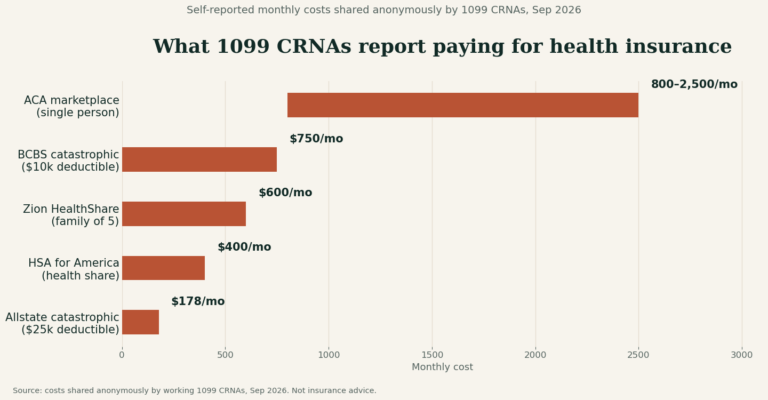
Before we get into the things that split these contributions apart, there is one point that definitely needs to be made. The truth is that health insurance is the one place where a W2 job almost always wins against a 1099 role. Granted, some W2 jobs offer poor quality health insurance benefits, but even then, the options available with private insurers are often worse. 1099 CRNAs also do not qualify for the subsidies in ACA marketplace health insurance because we often make too much for that. Hence, we are left with private health insurance options that are often very expensive and cover less.
When it comes to health insurance as a 1099 CRNA, the gold standard is to be married to a spouse with good health insurance from his/her employer. Even a spouse with bad health insurance options is often better than going it on your own. Being able to join said spouse’s plan removes a lot of headaches and hoop-jumping from your 1099 journey. If you do not have this option, then let me go over one of the few plus sides of the 1099 journey in regards to health insurance.
The S-Corp Health Insurance Premium Deduction
This is the benefit most W2 CRNAs are usually unaware of and it helps improve the math a bit.
If you are operating as a 1099 CRNA through an S-corporation — which, for most of you, you should be — you can deduct your health insurance premiums as a business expense. Specifically, you can deduct the premiums you pay for yourself and your family above the line, which means before you calculate your adjusted gross income. This is not a minor benefit. At CRNA income levels, this deduction can reduce your federal tax liability by a significant amount.
Here is a simplified example. Say your private health insurance plan costs $1,500/month, or $18,000/year. If your effective federal tax rate is 24%, that deduction saves you approximately $4,320 in federal taxes. Your real out-of-pocket cost for that $18,000 premium is closer to $13,680 — or $1,140/month.
While that’s still real money, it’s a different number than $1,500, and the difference matters when you’re doing your W2 versus 1099 comparison.
Talk to your CPA about how to structure this correctly — the deduction has specific rules around how it flows through the S-corp — but do not skip this step. Ignoring it means overestimating your true health insurance cost as a 1099 CRNA.
All Plans Are Not Equal. All Savings Are Not Equivalent.
Take the example of Cindy CRNA, as a W2 CRNA, Cindy had a PPO health insurance plan with her employer that covered her, her spouse and her child. Her monthly premium on that was $1,650 a month. Her employer also paid an amount towards her health insurance. With that plan, she paid a flat co-pay each time she saw a doctor. As a 1099 CRNA, she now pays $1,650 for a HDHP plan that covers herself, her spouse and her child. The mechanics are different. With an HDHP, there are no co-pays before the deductible. She pays the full allowed cost of every visit until her deductible is met.
At first glance, it appears that Cindy has hacked the system and managed to keep her health insurance costs equivalent between both roles, however, that is not accurate. To truly calculate the total difference in healthcare costs between your 1099 and W2 roles you must first of all be comparing apples to apples. Cindy went from a PPO plan to a HDHP plan. PPO plans generally have higher monthly premiums than their equivalent HDHP plans.
Hence, as a W2 staff, if Cindy was paying $1650 for a family PPO plan then she would probably have been paying about $1,000 for a family HDHP plan. But instead when she went solo, she is paying $1,650. Why is this? The fact is that health insurance coverage in America outside of those provided by an employer are not quite as great. Also, the HDHP plan that would have cost $1,000 as a W2 staff only costs that low because her employer would essentially be covering the difference of $650 (as seen with her solo health insurance coverage). This is something you would have to factor in when calculating your switch.
Let us now walkthrough the calculations in real time.
The Total Annual Health Insurance Cost Formula
Most people only compare monthly premiums. That’s the wrong starting point. The number you actually need is your Total Annual Health Insurance Cost, which has three components:
Total Annual Cost = Monthly Premiums × 12 + Annual Out-of-Pocket Medical Spend + Any Uncovered Costs
You calculate this for your W2 plan. Then you calculate it for your 1099 plan. The difference is what health insurance actually costs you to go independent.
Step 0: Build Your W2 Baseline
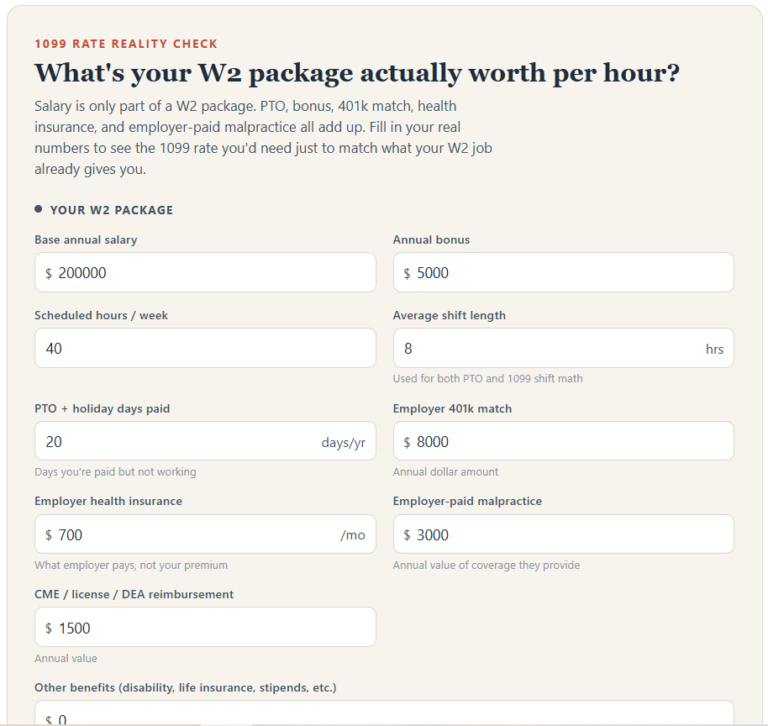
Before you can evaluate 1099, you need to know what your W2 health insurance actually costs — your share plus what your employer pays on your behalf.
| Cost Component | What It Means | Where to Find It |
|---|---|---|
| Your monthly premium | What comes out of your paycheck | Your pay stub or HR portal |
| Employer monthly contribution | What your employer pays on top | Benefits summary or HR |
| Combined monthly premium | True cost of your plan | Add both together |
| Annual deductible | What you pay before insurance shares costs | Your insurance card or benefits portal |
| Out-of-pocket maximum | The most you’ll ever pay in a year | Same as above |
| Actual medical spend last year | What you actually paid for visits, Rx, labs | Credit card/bank statements, Jan–Dec |
Meet Alex CRNA
Alex is a W2 CRNA with a spouse and two children. Her employer offers an HDHP as part of their benefits package. She’s considering going 1099 and wants to know exactly what health insurance will cost her on the other side.
Step 1: Build Alex’s W2 Baseline
As a W2 CRNA on a family HDHP, Alex’s costs look like this:
| Cost Component | Amount | Notes |
|---|---|---|
| Alex’s monthly premium | $1,100 | Comes out of her paycheck |
| Employer monthly premium contribution | $800 | Paid directly to insurer — Alex never sees this |
| Combined true monthly premium | $1,900 | What the plan actually costs |
| Annual deductible | $3,400 | Family HDHP IRS minimum 2026 |
| Out-of-pocket maximum | $8,000 | Family HDHP typical |
| Employer HSA contribution | $1,000/yr | Many employers seed the HSA — often overlooked |
| Alex’s annual medical spend (actual) | $2,400 | Pulled from 12 months of statements |
W2 True Annual Cost Breakdown
| Component | Alex Pays | Employer Pays |
|---|---|---|
| Annual premium (×12) | $13,200 | $9,600 |
| Annual medical spend (visits, Rx, labs) | $2,400 | — |
| Employer HSA seed (offsets Alex’s OOP) | -$1,000 | $1,000 |
| True annual total | $14,600 | $10,600 |
| Combined true cost of plan | $25,200 |
The number Alex sees and thinks about is $14,600. The number that actually matters when evaluating 1099 is $25,200 — because she is about to absorb all of it herself.
Step 2: Price Out Alex’s 1099 HDHP
Alex goes to a private health insurance broker and prices out a comparable family HDHP. One with the same plan type, similar deductible and network structure.
| Cost Component | Amount | Notes |
|---|---|---|
| Monthly premium (Private Plan) | $1,900 | Comparable family HDHP, no employer subsidy |
| Annual premium (×12) | $22,800 | |
| Annual medical spend (estimated) | $2,400 | Same family, same usage patterns |
| HSA contribution (Alex funds herself) | $8,750 | 2026 IRS family HSA max — pre-tax dollars |
| HSA tax savings (at 24% effective rate) | -$2,100 | Pre-tax contribution reduces taxable income |
| S-corp health insurance deduction | -$5,472 | 24% of $22,800 annual premium |
| True net annual cost | $26,378 | After all tax advantages applied |
Why is the Private Plan premium $1,900 vs. her W2 share of $1,100?
On a W2 plan, Alex’s employer was absorbing $800/month of her premium. That subsidy disappears entirely when she goes 1099. She isn’t paying more for the same plan — she is now paying the full cost of a plan that was never actually $1,100 to begin with.
Step 3: The Actual Comparison
| W2 Plan | 1099 Plan | |
|---|---|---|
| What Alex thought she was paying | $14,600/yr | — |
| True total cost of plan | $25,200/yr | — |
| 1099 net cost after deductions | — | $26,378/yr |
| Annual gap | $1,178 more on 1099 | |
| Monthly gap | $98/mo more on 1099 |
Step 4: Convert to an Hourly Rate
| Annual Gap | Hours Worked/Year | Additional Rate Needed |
|---|---|---|
| $1,178 | 1,800 hrs | $0.65/hr |
| $1,178 | 2,000 hrs | $0.59/hr |
For Alex, the entire health insurance differential comes down to less than $1/hr on her contract rate.
Health insurance is the one benefit category where W2 employment has a legitimate claim. But legitimate does not mean insurmountable. For most CRNAs in most markets, once you surface the employer subsidy you were never actually seeing, apply the S-corp deduction, and max your HSA, the gap narrows to a number that a well-negotiated contract rate can close.

One Comment